Chapter 3: Asynchronous Messaging
Asynchronous messaging basics.
Messaging Primitives #
Message Queues #
Queues that store a sequence of messages
Producers #
Send messages to queues
Consumers #
Retrieve messages from queues
Message Brokers #
Manages one or more queues
-
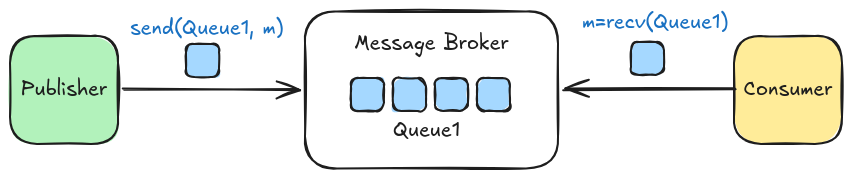
A message broker is a service that manages one or more queues.
-
When messages are sent from producers to a queue, the broker adds messages to the queue in the order they arrive (FIFO).
-
The broker is resonsible for efficiently managing message receipt and retention until one or more consumers retrieve the messages, which are then removed from the queue.
-
A producer will wait until an acknowledgement message is received from the broker before the send operation is considered complete.
-
There are two modes of behaviour for consumers to retrieve messages, known as pull or push.
-
In pull mode, also known as polling, consumers send a request to the broker, which respons with the next message available for processing. If there are no messages available, the consumer must poll the queue until messages arrive.
-
In push mode, a consumer informs the broker that it wishes to receive messages from a queue. The consumer provides a callback function that should be invoked when a message is available.
-
-
Consumers will also acknowledge message receipt. There are two modes for acknowledgement:
-
Automatic acknowledgement, where messages are acknowledged as soon as they are delivered to the consumer and before they are processed.
-
Manual acknowledgement, where messages are acknowledged if and only if it has been successfully processed by the consumer.
-
Message Persistence #
-
Queues can be configured to be persistent.
-
When a message is placed on a queue by a producer, the operation does not complete until the message is written to disk.
-
Persistent queues have an inherent increase in the response time for send operations.
Publish-Subscribe #
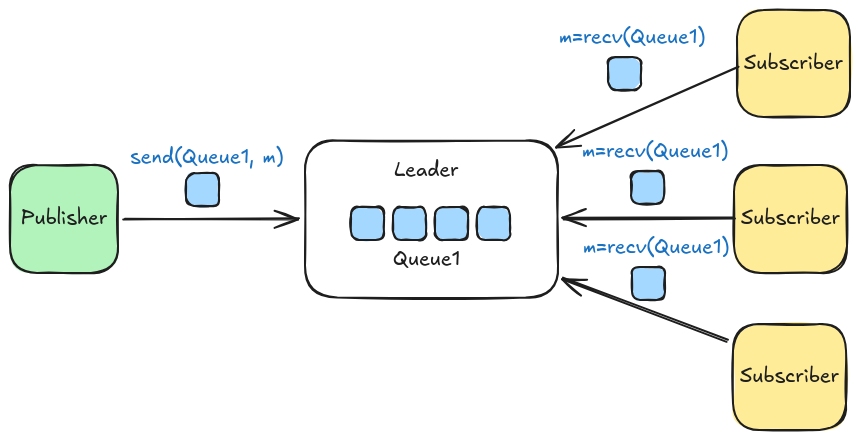
- A one-to-many messaging architecture where messages are sent from one publisher to multiple subscribers.
Message Replication #
-
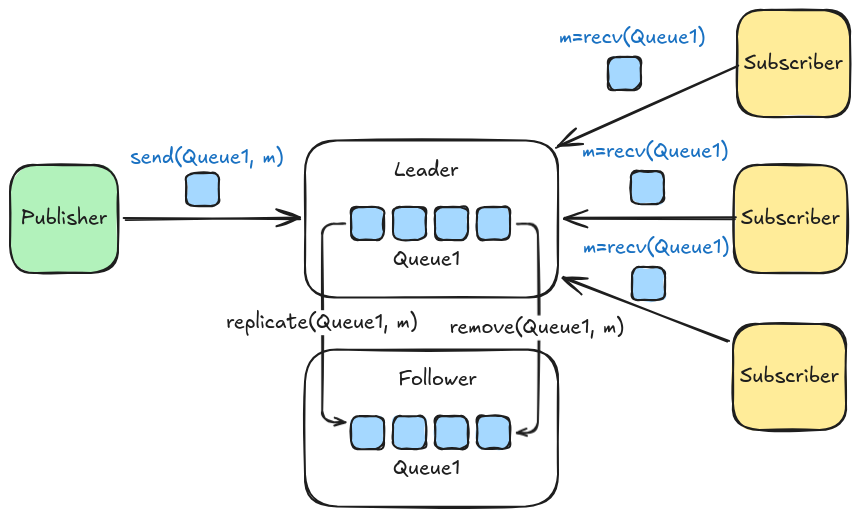
Message brokers can enable logical queues and topics to be physically replicated across multiple brokers, each running on their own node.
-
If one broker fails, then producers and consumers can continue to process messages using one of the replicas.
Messaging Patterns #
Read this to learn more about the different messaging patterns.
Competing Consumers #
Read this.
Exactly-Once Processing #
-
Ensures that even if a system fails, retries, or experiences network issues, each message is processed, its state updated, and output produced exactly once.
-
This prevents duplicates and data loss in distributed systems.
Poison Messages #
Read this.
Learn about dead letter queues