
Clean Architecture
Clean Architecture Summaries
Part 1: Introduction #
Chapter 1: What is Design and Architecture? #
- Software Architecture's goal (according to Uncle Bob) is to minimize the human resources required to build and maintain the required system.
Chapter 2: A Tale of Two Values #
-
Every software system provides two different values to the stakeholders:
- Behaviour
- Structure/Architecture
-
Software developers are responsible for keeping these values high.
-
Behaviour: The requirements or functionality of a machine that makes or saves money for the stakeholders.
-
Architecture: The structure of Software that determines how easy it is to be changed.
-
Eisenhower's Matrix: Prioritize base on urgency and importance.
- Urgent and important
- Not urgent but important
- Urgent but not important
- Not urgent and not important
-
The role of the Software Architecture is to allow features and functions to be easily developed, modified, and extended.
Part 3: Design Principles #
Chapter 7: The Single Responsibility Principle (SRP) #
- A module should be responsible to one, and only one, actor
A module is a cohesive set of functions and data structures (ie. a file, a class, etc.).
Chapter 8: The Open-Closed Principle (OCP) #
-
A software artifact should be open for extension but closed for modification.
-
The goal of OCP is to make the system easy to extend without incurring a high impact of change.
Chapter 9: The Liskov Substitution Principle (LSP) #
-
If for each object of type there is an object of of type such that for all programs defined in terms of , the behaviour of is unchanged when is substituted for , then is a subtype of .
-
TL;DR - Programs using an object of type must still behave correctly even if 's subtype is used instead.
Chapter 10: The Interface Segregation Principle (ISP) #
- Modules must only depend on things that has all that it needs, nothing more, nothing less.
Chapter 11: The Dependency Inversion Principle (DIP) #
-
Dependencies refer only to abstractions, not to concretions.
-
If depending on concrete objects, make sure those objects are stable and not volatile to changes.
Part 5: Architecture #
Chapter 15: What is Architecture? #
-
Good architecture makes the system easy to understand, develop, maintain, and to deploy.
-
The ultimate goal is to minimize the lifetime cost of the system and to maximize productivity.
-
The way to keep software soft is to leave as many options open as possible, for as long as possible.
- The options that need to be left open are the details that don't matter.
-
All software systems can be decomposed into two major elements: policy and details.
-
Policy are business rules and procedures.
-
Details are those necessary to enable humans, other systems, and programmers to communicate with the policy, but that do not impact the behaviour of the policy at all.
-
Chapter 17: Boundaries #
- Business rules must not know about their technical details to make the architecture flexible.
Chapter 20: Business Rules #
-
An Entity is an object that embodies a small set of critical business rules that operate on critical business data.
-
The interface of the Entity consists of the functions that implement the critical business rules that operate on that data.
-
A use case specifies the input to be provided by the user, the output to be returned to the user, and the processing steps involved in producing that output.
-
A use case describes application-specific business rules.
-
Use cases contain the rules that specify how and when the critical business rules within the Entities are invoked.
-
Entities have no knowledge of the use cases that control them.
-
Chapter 21: Screaming Architecture #
-
The architecture of the system should tell its readers about the system ie. a health care app should be easily distinguishable as a health care app based on its source repository.
-
Good architecture should focus on use cases and not on the technical details.
Chapter 22: The Clean Architecture #
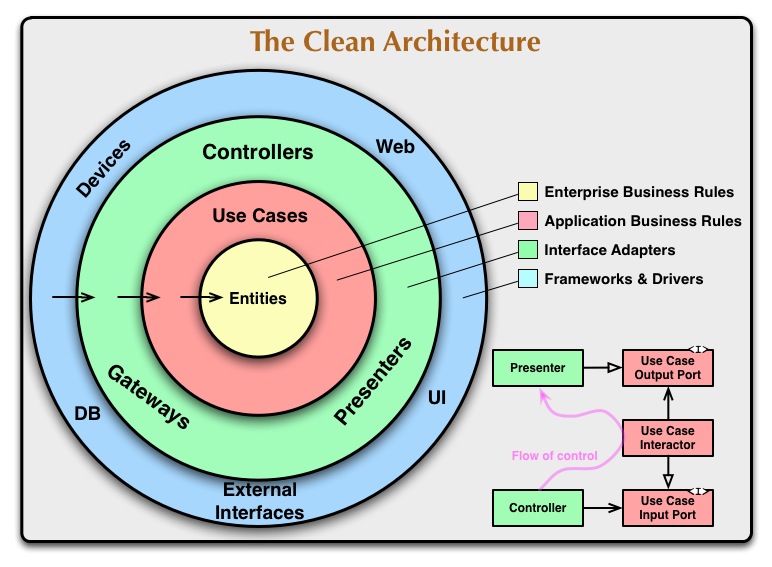
-
The Dependency Rule in Clean Architecture states that source code dependencies must point only inward, toward higher-level policies.
-
Entities are objects that encapsulate critical business rules.
-
Use Cases contains application-specific business rules and control the flow of data to and from the entities.
-
Interface Adapters are a set of adapters that convert data from the format most convenient for the use cases and entities to the format most convenient for some external details such as the database or the web.
-
Frameworks and Drivers are where all the details go (ie. web, database, frameworks, i/o)
Chapter 23: Presenters and Humble Objects #
-
The Humble Object pattern is a design pattern where the behaviour is split into two modules or classes. One of those modules is humble; it contains all the hard-to-test behaviours. The other module contains all the testable behaviours that were stripped out of the humble object.
- The View is the humble object that is hard to test.
- The Presenter is the testable object.
-
The job of the Presenter is to accept data from the application and format it for presentation so that the View can simply move it to the screen.
- The View Model is a simple data structure that the Presenter uses to fill in details with so that the View can find it.
View this video for an example usage. TL;DR Humble Object = An instance of DIP.